
News in a New Era: Connecting, Communicating and Caring in the Modern Media World

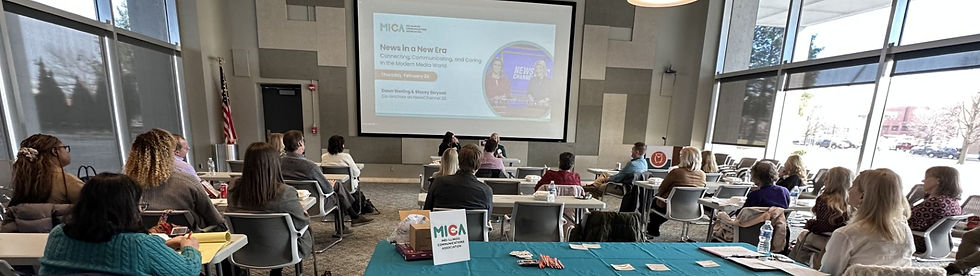
Journalists Dawn Sterling and Stacey Skrysak, television news anchors on NewsChannel 20 in Springfield, presented the Lunch & Learn program “News in a New Era: Connecting, Communicating and Caring in the Modern Media World” to members of the Mid-Illinois Communications Association and guests.
The intent of the presentation, Stacey said, is to “show you how relevant our work still is,” despite the dramatic evolution of their profession over the years.
“It is shocking how much it has changed, honestly, in the last 10 years,” Dawn said. For example, they used to get most of their story ideas and news tips from people calling into the newsroom. Now, most of their tips and leads originate on social media.
Changes in Technology
Stacey recalled that when she was looking for her first job in broadcast news, she sent out 80 tapes to stations across the country. In addition, early in her career, she had to “do it all,” including shooting video, writing scripts, and doing weather and farm reports.
“I am a better journalist because of that experience,” she said.
Dawn observed that earlier in her career, it took most of the day to edit video for a story to be aired on that day’s newscasts. As a result, reporters often didn’t have a lot of time to develop a story because they needed to spend so much time on editing.
Now, she says, editing is much faster, which means reporters have more time to develop stories before they air.
Credibility and Humanity Matter
In today’s world, everyone has a camera in their pocket because they carry smartphones, Dawn said. And even though anyone with a camera might call themselves a “journalist,” she noted that she and her colleagues are TRAINED JOURNALISTS. They have standards (such as verifying information before broadcasting it), ethics, and accountability.
But the self-proclaimed “journalists” don’t necessarily share those values – and the information they share isn’t necessarily true.
Dawn and Stacey said part of their job is to meet viewers and prospective viewers “where they’re at,” and these days, that means on social media, especially on Facebook.
They’re careful not to post personal opinions, but they do show their humanity by sharing some personal stories. Showing humanity is crucial in building trust with people.
For example, people who were directly affected by the Chatham car crash that killed five children last spring were firm about talking only with Stacey because they knew from her social media posts that she’d experienced similar loss. Once Stacey started talking with one of the families, then other Chatham families agreed to be interviewed, too.
What About AI?
Dawn and Stacey agreed that artificial intelligence tools can be helpful and great time-savers, such as in writing headlines. A big problem with AI, though, is you’re not using your own brain or “the human spirit,” Dawn said. The human element is vital for good journalism.
Stacey said she uses Otter, an AI tool, for transcribing interviews, summarizing, and inserting time codes. Dawn added that she and Stacey both were initially reluctant to adopt some of the newer technologies, but “you have to roll with the times.”
Additional Thoughts
Stacey and Dawn offered further real-life examples of powerful, positive uses of social media for their jobs:
Posting on Instagram a photo of an adorable child who needed a kidney. (The child got the kidney.)
Using Facebook Live to let people know immediately about the verdict in the Grayson case (involving the killing of Sonya Massey).
During a robust question-and-answer session with the audience, Dawn and Stacey were asked about many people’s difficulty when it comes to distinguishing what’s real or not, and about the concept – popular among some – that journalists cannot be trusted.
That concept is misguided, they agreed. “We are unbiased journalists,” Stacey said. Becoming “engrained in your community” and showing that you’re invested in your community make a real difference in building trust, Dawn added.
Audience members talked about how, when they were young, they took classes in civics and current events that helped them learn to evaluate what’s true and what isn’t. Some audience members asked: Where’s that kind of education now?
The Future of Journalism
Dawn and Stacey noted they’re seasoned journalists who have spent much of their careers in Central Illinois. They mentor younger colleagues, helping them to become better broadcast journalists. Dawn and Stacey are sources of “institutional knowledge,” meaning they know key facts and context about the region and about major news stories of the past. Those sorts of details can enable a younger reporter to ask better questions and put together a better story than they might have done otherwise.
Developing young journalists is essential, yet challenging, they said. A journalist’s job is to hold people accountable and ask the tough questions – not to be liked by everyone. While the job isn’t a good fit for everyone, there are talented young journalists out there doing the work.
Dawn said young journalists need to discover what their passion is in reporting because she believes the future of the profession lies in specialty reporting – focusing on a specific subject like lifestyle, politics, or health.
Members, log in to view the full presentation.


