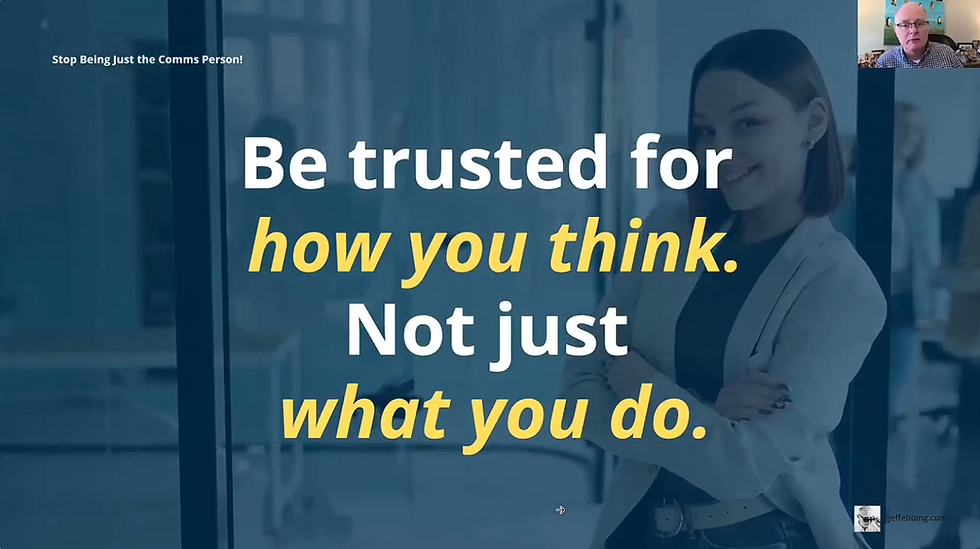
Communicating with Gen Z: What Actually Connects?

Members, log in and view the presentation
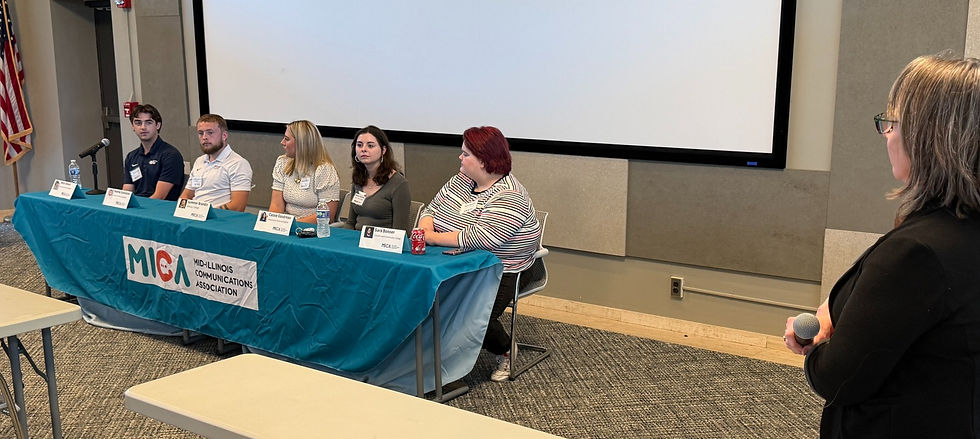
The Mid-Illinois Communications Association hosted a Lunch & Learn on April 22, 2026, that featured five college students in a panel discussion titled “Communicating with Gen Z: What Actually Connects?”
MICA’s immediate past president, Michelle Eccles, moderated the question-and-answer session with the students, who are all members of “Generation Z.”
Here are the names of the panelists, along with their school and their field of study:
Sara Bonner, Lincoln Land Community College: Integrated media design
Cassie Goudreau, University of Illinois Springfield: Business administration, marketing
Summer Brandis, Illinois College: Organizational and strategic communication and human resource management
Andrew Synoradzki, University of Illinois Springfield: Business administration, marketing
Mitch Olenick, University of Illinois Springfield: Master of Business Administration
The panelists offered a variety of views, sometimes agreeing with each other and sometimes not. Highlights from the discussion are presented in Q&A format below. MICA members can watch video of the discussion on the Members Only section of the MICA website.
Communicating and Worrying
Question: What is one word that describes how Gen Z communicates today and why?
Mitch: The first word that comes to mind is “apprehensive”. In my role on the men’s soccer team, I have noticed younger guys are more reserved in person and more direct online.
Andrew: I would say “adaptable” describes how Gen Z communicates. They may interact one way with their peers and another way with others from different generations. In other words, they’re changing the way they speak to people, depending on the audience.
Summer: The first word I thought of was “fun,” like adding exclamation points in an email instead of a period so people don’t think they’re mad at them. Very fun and very personable.
Cassie: The first word that came to mind was “humor” – follow trends and try to make people laugh.
Sara: We’re pretty open about how we feel, and expressing our needs. I would say we’re “open.”
Q: Are you worried about the future and why?
Sara: I feel that everyone growing up, in their late teens and early 20s, is worried and uncertain about their future. There’s also a lot of fear with AI and technology now.
Cassie: The unknown is scary. That’s why it’s important for us to keep learning – about tools, technology and the world in general.
Summer: AI is scary, and there are a lot of unknowns, but I’m excited by the free resources available online so we can keep learning on our own.
Andrew: I feel uncertain about my future. Business is a competitive field, with a lot of people interviewing for the same jobs and internships. It’s hard to know if the role we’re being educated for now will even exist in the future. It’s important to be able to adapt and learn.
Mitch: I’m anxious and excited about the future. We don’t trust a lot of things as a generation. We like to fact-check things. Yet we’re probably very prone to sometimes just believing what is on the internet. I’m always asking myself “what do I think about this” and “how can I find out more.”

Consuming Media and Grabbing Attention
Q: What is the best way to reach your generation? How do you consume media, and where are you getting your media from?
Mitch: Mainly Instagram. I follow NPR on Instagram but don’t listen to NPR. The reputation of content providers, and the sources of their information, matter. Adding sources, e.g., links to studies, on social media posts adds credibility.
Andrew: Instagram is the biggest for our generation. Reels is the best and most common form of content. I agree that adding sources in the description adds credibility.
Summer: Facebook is where I get my news. I follow a lot of local news on Facebook. My mom also sends me news articles, all from Facebook. Also TikTok. I make sure what I’m reading/watching is verified from a well-known source.
Cassie: Instagram and YouTube. I don’t really use TikTok or Snapchat. Different platforms engage different people.
Sara: YouTube, Instagram, TikTok.
Q: What grabs your attention and makes you want to stay on something and learn more about it?
Sara: If something tells me to “stop scrolling,” I ignore it. They’ve already lost me. I scroll past it.
Cassie: If I see the phrase “did you know” or “if you do this,” I just scroll past that. I connect with videos that seem really interesting right away – they’re doing something or showing something, rather than focusing on trying to make you stay. Showing/doing something is a good way to intrigue audiences.
Summer: Short-form video is important. I’ll scroll past anything that’s more than 2 minutes – unless I can speed it up to 2X normal speed.
Andrew: Sometimes, less is more. If I immediately feel I’m being sold something, or being told to do something, it’s a turnoff.
Mitch: If a video looks professionally made, with a better camera, I’m more likely to watch it.
Audience Follow-up: I was just told that polished is less attractive to viewers because it doesn’t look as authentic. What do you all think about that?
Mitch: I like a clean look. Not text in one corner, and different text in another corner, and too much going on.
Andrew: Professionalism creates credibility. If your videos look the same, are filmed with the same high-quality camera, that establishes professionalism.
Mitch: Building on what Andrew said: If I like a video and click on the creator’s profile to look at their grid, I’m more likely to follow them or watch a lot of their videos if their grid looks professional. But if only one video looks professional and the rest look thrown together, I’m more likely to move on.
Summer: I would say the iPhone camera looks more authentic. My experience in posting on social media for different accounts is that the camera-quality videos don’t get as many views. Authentic iPhone trending videos get you views, and that makes the audience want to check out your profile to learn more about you.
Cassie: I think it depends. What’s more important to me is consistency. If I like a video and want to see more from that creator, I want to see the same style. If I like something, I want to see more of it – whether that is professional or authentic.
Sara: I agree that it depends. Presentation matters. A lot of polish can be nice, but you also have to be authentic.
Staying Grounded and Informed
Q: You’ve talked about anxiety being produced in the world now. What helps you stay grounded and connected and engaged when you’re facing such challenges?
Sara: Focusing on the things that I can control, vs. the things I cannot control.
Cassie: Focusing on continuing to learn and developing my skills. E.g., with the uncertainty because of AI, learning more about it and how to leverage it as a tool.
Summer: Taking breaks is important. I go on walks and use the phone to make calls and try not to let social media platforms take over my life.
Andrew: Have a plan, be persistent, believe in yourself. Keep building your skills and making connections.
Mitch: I agree with Andrew. Also: reading and working out. Lately, I’ve been reading fantasy and fiction because it takes my mind away from other parts of the day, like working and playing soccer. It takes stress away.
Q: How do you find out what’s going on in your community? What resources do you turn to, if you want to find out about an event? Would you be interested in, for example, podcasts or of interviews with journalists explaining how they got a story, or panel discussions with the sources? What would be helpful to you as you look to verify or understand the news you’re seeing?
Mitch: I find my news/information through Instagram accounts that I follow and think are credible. I don’t think I would turn on a podcast unless it was from a big name, or if a big-name guest from that [subject matter] was on it, or someone I know. When our generation finds a couple of people we like on social media, we stick with them and their content, and then the algorithm gives us more content in the same niche.
Andrew: It’s hard to establish credibility on social media because a lot of the content is rubbish. A lot of people with high followings tend to speak the truth. If I were looking for things that are truthful, I would look for primary sources.
Summer: I’m from around here. I rely on Illinois Times and local news channels. Having local resources that I know are credible is enough for me.
Cassie: I get my news from social media and then follow up to learn more from credible websites. I look for informative posts that are clear and concise, and that present the facts in a straightforward way. I also want them to point to additional resources so I can find out even more.
Sara: Sometimes, I get my news from classmates, by word of mouth. I like to check Illinois Times and the State Journal-Register. I think about the source’s bias about the subject, and I keep that in mind as I form my own opinion.
Q: Do you mind sharing what are some credible sources to you?
Mitch: I don’t know the exact names of the accounts. I don’t follow CNN, Fox or anything like that. I will see the headlines. I could get my phone and tell you later.
Audience follow-up question: So, are they organizations or individuals?
Mitch: It’s the name of an account that may be an organization with multiple people running it. It’s very much an independent news source that has no connections to big media outlets. Our generation is very untrusting toward those.
Andrew: One person comes to mind. He’s a well-known soccer agent, Fabrizio Romano. In the soccer world, he’s known as the guy with the newest, most credible information. He has the biggest following. He has amazing connections to managers and players.
Summer: I don’t think there’s anyone I follow.
Cassie: If I see something news-related on Instagram, for instance, it’s helpful to see in the bio where they got the information, where it was published and when, and where I can find out more.
Sara: I don’t trust Facebook. I feel like anyone can make up anything and just post it. Some people will take it as fact. If it’s really important, I look at Illinois Times, the SJR, WAND-TV, or word of mouth – what are my friends saying?
Brand Loyalty?
Q: In the context of marketing, are you already “stuck” on your brands, or can you be persuaded to change?
Sara: I don’t really believe in brand loyalty. I could be persuaded to change toothpaste. I couldn’t be persuaded away from shopping at ALDI.
Cassie: I’m not loyal to brands in terms of clothes or where I shop. I could be persuaded to change.
Summer: If an influencer is using it and gives me a credible reason about why I should use it, I will switch brands. The only thing I won’t switch is Diet Coke. I have switched energy drinks based on influencer videos.
Andrew: Endorsements matter, especially in athletics. I would switch brands if I thought I was getting a good value.
Mitch: We’re a trendy generation, for example, with water bottle brands.
Further Comments and Wrapping Up
Here are some additional comments from the panelists.
Andrew: There are differences within Gen Z. Younger members may prefer texting to talking; that could be because of when they experienced the Covid lockdown.
Sara: Growing up online, we’ve learned it’s OK to say pretty much anything because there are basically no consequences. It’s different in person.
Asked what assumptions about their generation drive them crazy, the responses included: assuming that members of Gen Z don’t want to work, assuming that they are all adept at technology, assuming that they are all anti-social, and assuming that they complain a lot – though the complaints often are valid.
MICA thanks the panelists for taking time from their busy schedules to share their insights!
Members, log in to view the full presentation.