
Stop Being Just the Comms Person: How to Lead, Influence, and Build Trust without a Bigger Title (Yet)
Jeff Ebbing, director of marketing and communications at Southeastern Community College in Iowa, presented the webinar “Stop Being Just the Comms Person: How to Lead, Influence, and Build Trust without a Bigger Title (Yet)” on March 25, 2026, to members of the Mid-Illinois Communications Association and guests.
Jeff opened by saying his presentation would be a practical discussion that might be a bit “subversive,” but this is about taking control of our jobs. He conducted a couple of quick surveys of the audience. The first asked: Which situation (from a selection of 5 or 6 options) frustrates you the most in your role? The leading response was: I’m brought in after decisions are made. The second-leading response was: Everyone thinks they know how to do marketing.
He pointed out that no one will ever care more about your career than you do. So your professional growth is up to you. Jeff mentioned his admiration of the Seth Godin blog. The March 25, 2026, edition included this passage: “Our first job is to do work that matters for people who care.”
Jeff cautioned about what he calls the Rock Star Doer Trap – i.e., the more capable you are, the more work you get. We have to find ways to do other kinds of work and not get caught in a rut.
Reactive vs. Proactive
We need to look ahead and set goals. Align the work to the goals, Jeff said.
If you don’t decide what you’re optimizing for, then something/someone else will decide for you, he added.
Non-marketers often wrongly regard marketing as advertising. But it should be viewed as strategic work.
How Communicators Build Influence (Part One)
Bring your expertise, and adopt these behavior shifts.
Behavior Shift #1: Frame Decisions Trusted advisors ask questions first. Don’t just automatically do the work that comes in. (“I need a Facebook page.”) People are coming to us with the “prescription,” but they probably have made the wrong “diagnosis.” (Do they really need a Facebook page?) We should frame the request by asking questions such as: What is the problem we’re trying to solve? How will we know that what we’re doing turned out to be a success? People might not have the full answers, but it forces them to think more, and this is how you start building influence. “Risk and Rate Must Equate.” In other words, expectations must match resources.
Behavior Shift #2: Control Scope “You don’t need a rocket ship to cross the street,” Jeff said. Don’t get caught up in overbuilding, e.g., using fancy tools that require a lot of training when a simpler tool can do the job. Not Everything Needs to Stay on the Board. Jeff said that as marketers, we’re notorious for adding and adding, without also pruning. If everything is urgent, nothing is strategic. Look at the work, then determine what’s worth your time, talent and treasure.
Behavior Shift #3: Outcomes will always outscore deliverables. Rather than reporting “Look at all these deliverables we did last month,” say that “We hit X mark,” or “The work impacted X,” etc. Show that there’s value to the work you’re doing. Track Signals. Use simple signals to make decisions. Don’t have 100 KPIs; make it a manageable number.
How Communicators Build Influence (Part Two) How to move beyond being “just” the comms person? Don’t wait for permission. Just start doing it. Focus on priorities, trade-offs and outcomes.
Set SMART goals. SMART = Specific, Measurable, Actionable, Relevant and Timely. Define your constraints and opportunities. Good goals don’t add work, according to Jeff. Instead, they optimize and organize work.
Kick the Crap to the Curb.
Focus on what makes a difference, and de-prioritize the rest, Jeff said.
Right-size Your Work“ Basic and simple” is better than “thorough and complex,” according to Jeff.
Ask What Worked
Ask: What did you do? What changed? Compared to what?
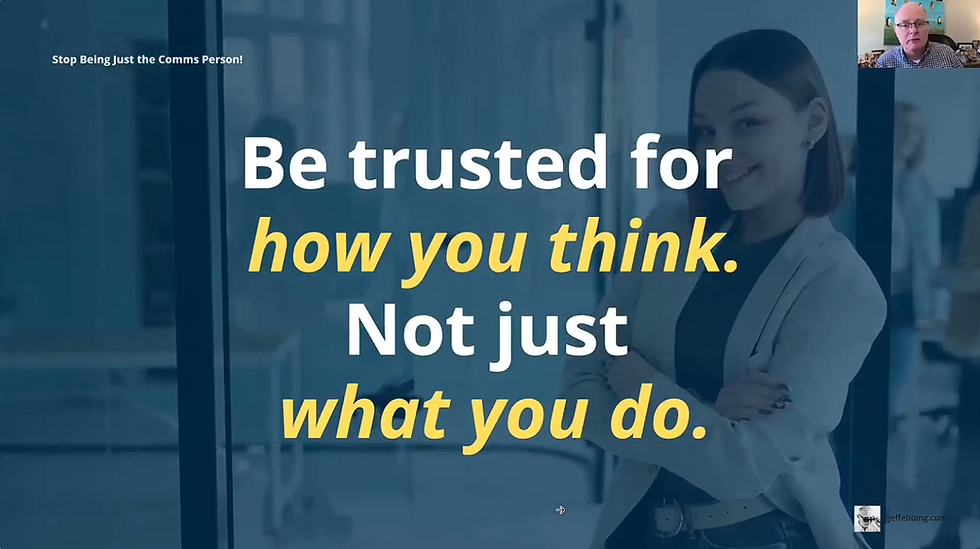
Jeff wrapped up his presentation with this thought: Be trusted for how you think, not just what you do.
Q&A During a robust question-and-answer session, Jeff addressed about a half-dozen questions. Here are a couple of them.
Question: Elaborate more on what this looks like – being bold and asking for permission later.
Jeff’s response: Set your own priorities first. When a task/project comes in, ask the requester questions, such as: Help me understand what the goal is. How will we know if it worked? If an executive/boss wants you to do something urgent, you can say, “OK, what priority should I drop to make time to work on this?” Jeff advised to politely push back and speak truth to power. Have the data and experience to back up your position.
Question: How to handle urgent requests and not let them derail your key projects?
Jeff’s response: If you can do the urgent request in a few minutes, do it. We all need to educate the people around us so there are fewer last-minute requests and so they understand that more lead time is needed. Sometimes, though, something has to fail before change can happen.
Jeff concluded by reminding the audience about helpful resources on his website, jeffebbing.com
Members, log in to view the full webinar.


